99Saturated
Introduction to Diversity, Equity, Inclusion and Accessibility (state employee guide)
Illinois Department of Human Rights · Training · 16,007 words
DEI ×97 · Equity ×39 · Microaggression ×30 · Latinx / Latine / folx / womxn ×28
Research
Jargon RadarLive: the terms rising in activist circles, plus the weekly roundup.Thermocline researchWhich activist ideas are crossing into the mainstream.Activism AuditGrade any training, syllabus or HR email for activist ideology.Follow the MoneyThe grants and gifts behind these ideas.The Two Tiers of CommunicationOne message for the base, a softer one for everyone else.Midterm war game1,000 AI strategists plan the next two years.Upload an employee training, a school syllabus, a policy or an HR email. The Activism Audit grades it on the Activism Index, highlights every activist term and where it came from, and gives you a one-page report to pass up the chain. See real examples in the Audit Library.
Your file never leaves your computer. Everything runs in this page; nothing is uploaded or saved.
Drop a file hereWord (.docx), PDF, email (.eml), web page (.html) or plain text
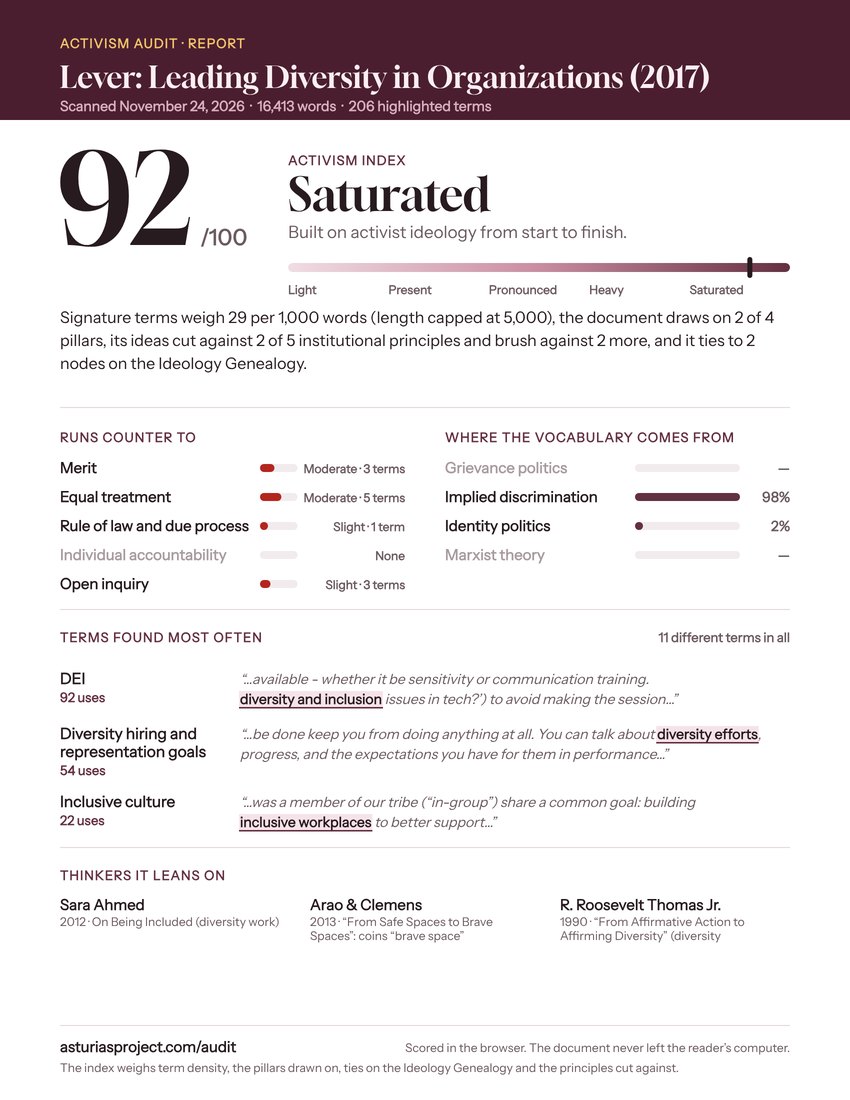 See a sample reportLever’s 2017 diversity handbook scored 92, Saturated
Activism Index
Runs counter to
The principles a fair institution runs on, and how this document’s ideas cut against them. Open one to see which terms and why.
Four things, each weighted: how densely the document uses signature terms per 1,000 words (common words like equity count at 40%), 45%; how many of the four pillars it draws on (grievance politics, implied discrimination, identity politics, Marxist theory; three or more counts in full), 20%; how many of five institutional principles its ideas cut against (merit, equal treatment, rule of law and due process, individual accountability, open inquiry), 20%. A principle counts in full once two signature terms, or several common ones, cut against it; a single passing term counts a third, and repeating the same term doesn’t add evidence. Four principles count in full; and how many ideas, thinkers and works it ties to on the Ideology Genealogy, 15%. The last three count in proportion to density, reaching full weight at 3 signature terms per 1,000 words, so a lone diversity statement in an otherwise ordinary document stays low. Courses, trainings, policies and emails are scored on the same scale. The score runs from 1 to 99. It measures reliance on this vocabulary, not intent; read the highlights in context.
Named in the text, or the founders behind the ideas and works it uses. Tap one to see it on the map.
highlighted terms
different terms, from 0 idea families
per 1,000 words
Solid underlines mark signature terms that rarely appear outside this vocabulary. Dotted underlines mark common words that carry an activist meaning in these settings, so read them in context: a document can use equity or marginalized in an ordinary sense. The glossary covers about 100 ideas and 600 phrasings, and grows as our research does.
Real course syllabi and workplace trainings, run through the Activism Audit and graded on the Activism Index.
University of Utah · Saturated. A doctoral course in education leadership built on social justice, critical race theory and decolonizing pedagogy.
Illinois Department of Human Rights · Training · 16,007 words
DEI ×97 · Equity ×39 · Microaggression ×30 · Latinx / Latine / folx / womxn ×28
University of Texas at Austin · Course syllabus · 4,643 words
Systems of oppression ×8 · Social justice ×7 · Climate / environmental justice ×6 · Antiracism ×5
University of Texas at Austin · Course syllabus · 5,609 words
Social justice ×15 · Positionality ×7 · Systems of oppression ×5 · Antiracism ×4
San José State University · Course syllabus · 4,245 words
Ethnic studies ×11 · Precarity / social reproduction ×8 · Settler colonialism ×6
Shared workshop document · Training · 396 words
Antiracism ×6 · Equity ×3 · Whiteness ×2
Shared workshop document · Training · 514 words
White privilege ×6 · Racial equity ×1 · Whiteness ×1
University of Utah · Course syllabus · 3,432 words
Social justice ×20 · Equity ×14 · Marginalized ×3 · People of color ×3
Shared with us by a reader
Shared workplace document · Training · 483 words
Antiracism ×17 · White supremacy (broad sense) ×2 · Implicit / unconscious bias ×2
University of Michigan Library · Training · 549 words
Antiracism ×13 · White supremacy (broad sense) ×5 · Trauma-informed ×4
University of Texas at Austin · Course syllabus · 7,848 words
Antiracism ×6 · Systems of oppression ×6 · Social justice ×4 · Trauma-informed ×2
Shared workshop menu · Training · 743 words
Implicit / unconscious bias ×7 · Equity ×5 · Microaggression ×4
P2PU · Training · 1,645 words
Microaggression ×8 · Implicit / unconscious bias ×3 · Privilege (identity sense) ×3
Seramount · Training · 1,726 words
Implicit / unconscious bias ×7 · Inclusive culture ×4 · Microaggression ×3
Shared training document · Training · 978 words
Implicit / unconscious bias ×18 · Gender identity ×1
University of Texas at Austin · Course syllabus · 5,303 words
Systems of oppression ×4 · Antiracism ×3 · Marginalized ×2 · Social justice ×2
San José State University · Course syllabus · 3,828 words
Critical race theory ×2 · Land acknowledgment / land back ×1 · Pronoun declarations ×1 · Transphobia ×1
Shared training document · Training · 9,722 words
Inclusive culture ×13 · Inclusive language ×11 · Implicit / unconscious bias ×2
San José State University · Course syllabus · 1,653 words
Diversity statements ×1 · Equity ×1 · Inclusive culture ×1
San José State University · Course syllabus · 1,821 words
Patriarchy ×1 · Gender identity ×1
San José State University · Course syllabus · 1,852 words
No activist terms found
San José State University · Course syllabus · 3,804 words
No activist terms found
Grades use the current Activism Index (see Sources and methods). Documents are public; we name institutions and courses, not individual instructors. Ordinary courses are included on purpose: plain syllabi score near the floor. Run your own document.