After the midterms: the Democrats’ likely playbook
We interviewed 1,000 simulated Democratic strategists the day after the 2026 midterms, each briefed on the results, the exit polls and the long-term trends, about how they would play the next two years. This is a war-game of how informed strategists might reason from the public record, not a poll of real operatives.
Would center the message on affordability and the cost of living. Democracy themes fell to 3%.
Would keep transgender issues out of the conversation. Childcare and family policy rose to 70%.
Want an impeachment push. 63% want targeted hearings on corruption and costs instead.
Messaging: prices first, everything else second
The simulated strategists read the midterms as a revolt over costs and almost all of them want to keep it there. Their slogans barely vary: “Lower costs, honest government, no drama.” “Your rent, your groceries, their tariffs. We fix it.”
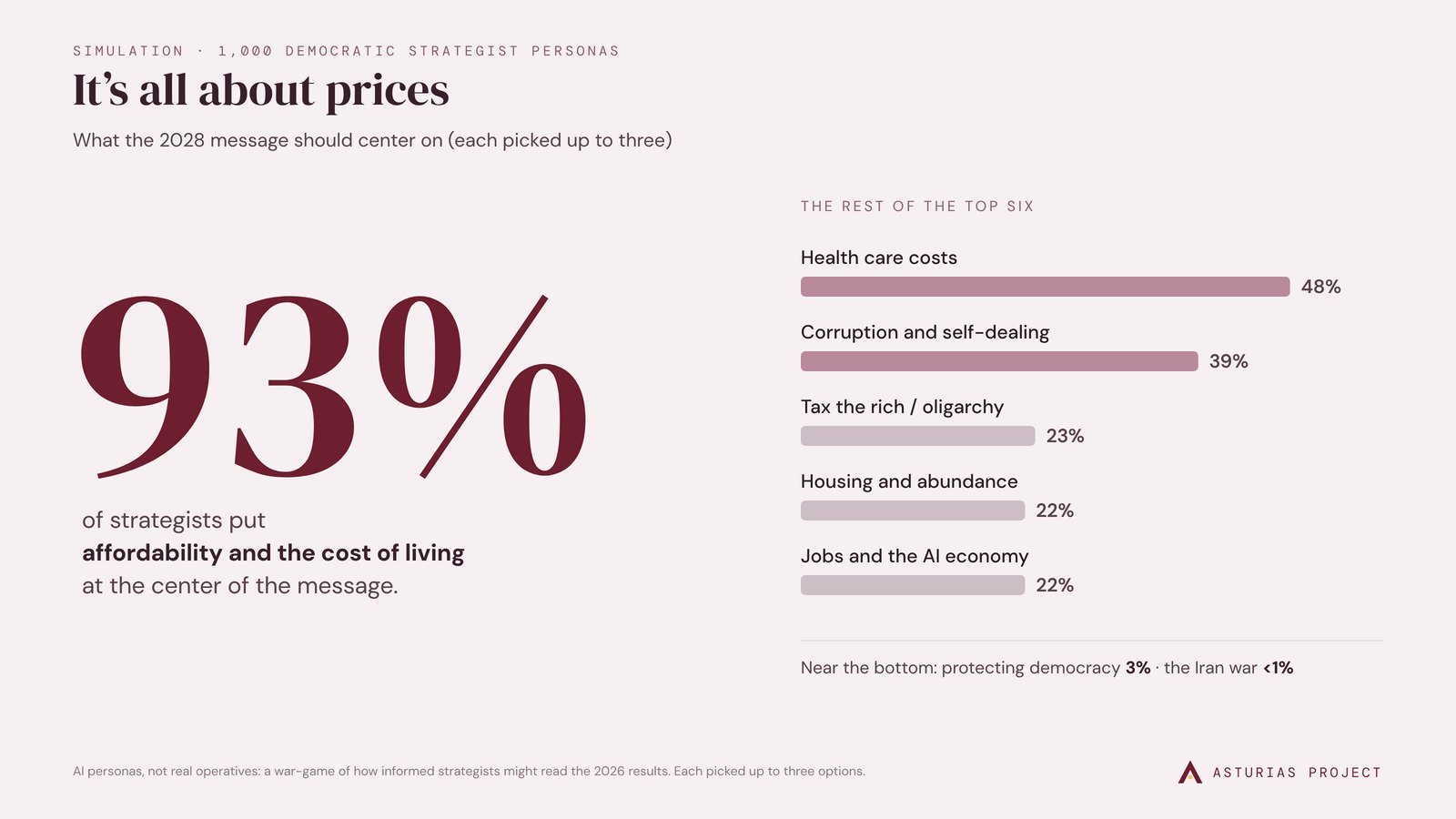
Each simulated strategist picked up to three frames.
Exit polls showed corruption mattering slightly more than cost of living. 39% want it as a lead frame, nearly all in the populist camp: “they’re cashing in while your costs go up.”
Only 3% would lead with protecting democracy. “No kings” holds on at 14%, as a patriotic way to talk about checks and balances.
Voters called the strike on Iran a mistake, but only 5 of 1,000 would campaign against it. They see foreign policy as risk with no upside.
Social issues: family, faith and safety in, identity out
They want the culture fight fought on ground where they think Republicans are weak. Nine in ten would mute transgender issues, including about 57% of progressive and democratic socialist personas. Abortion, the 2022 centerpiece, falls to 19%.
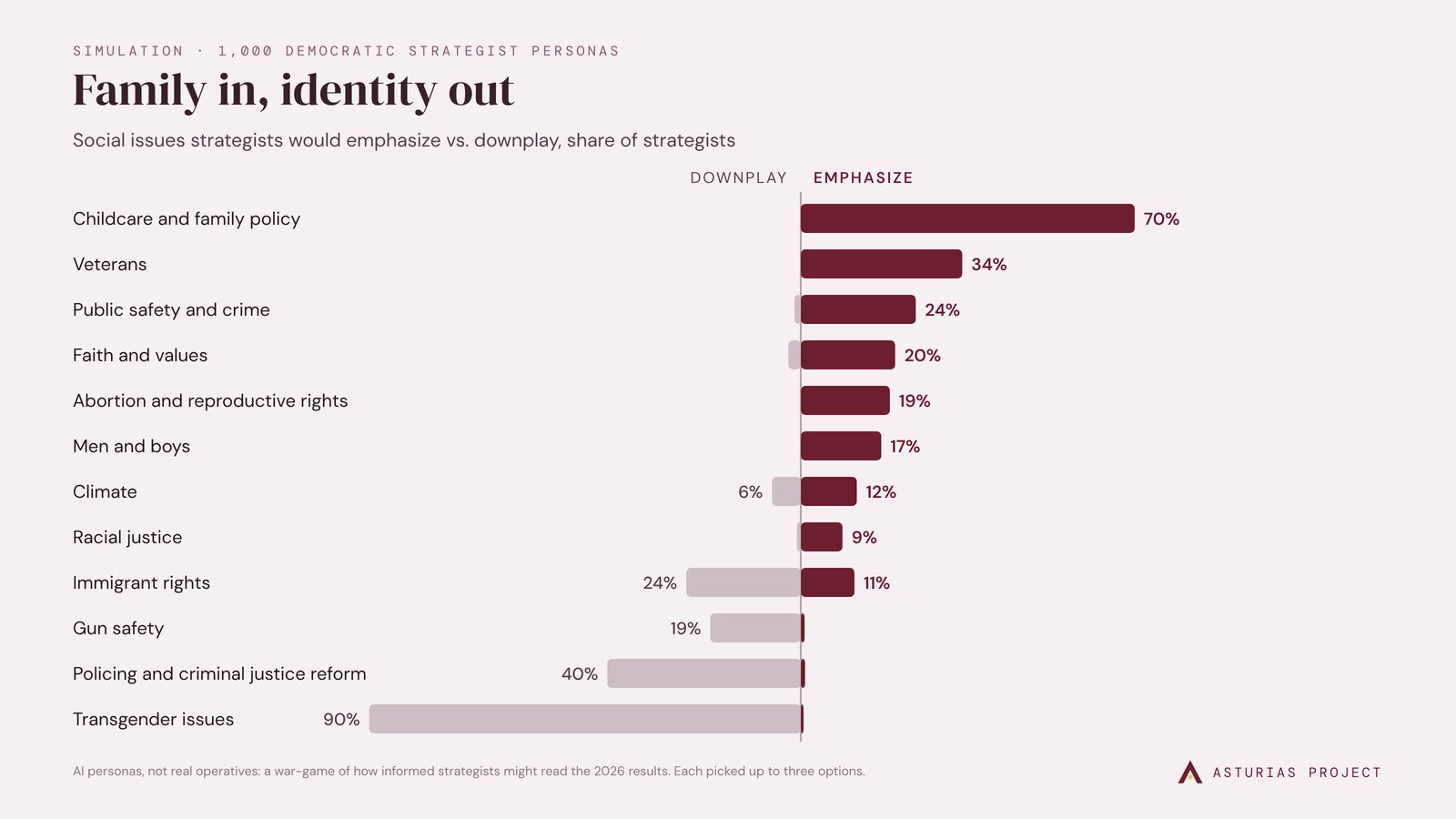
Up to three issues to emphasize and three to downplay. Faith rises to 46% among personas based in the South.
Attack posture: go after the record, not the man
Average aggression was 3.1 out of 5. The targets are MAGA members of Congress, Trump’s billionaire allies and the Trump family’s business dealings, tied to costs one vote at a time: “Name the senator, name the donor, name the dollar amount every single day.”
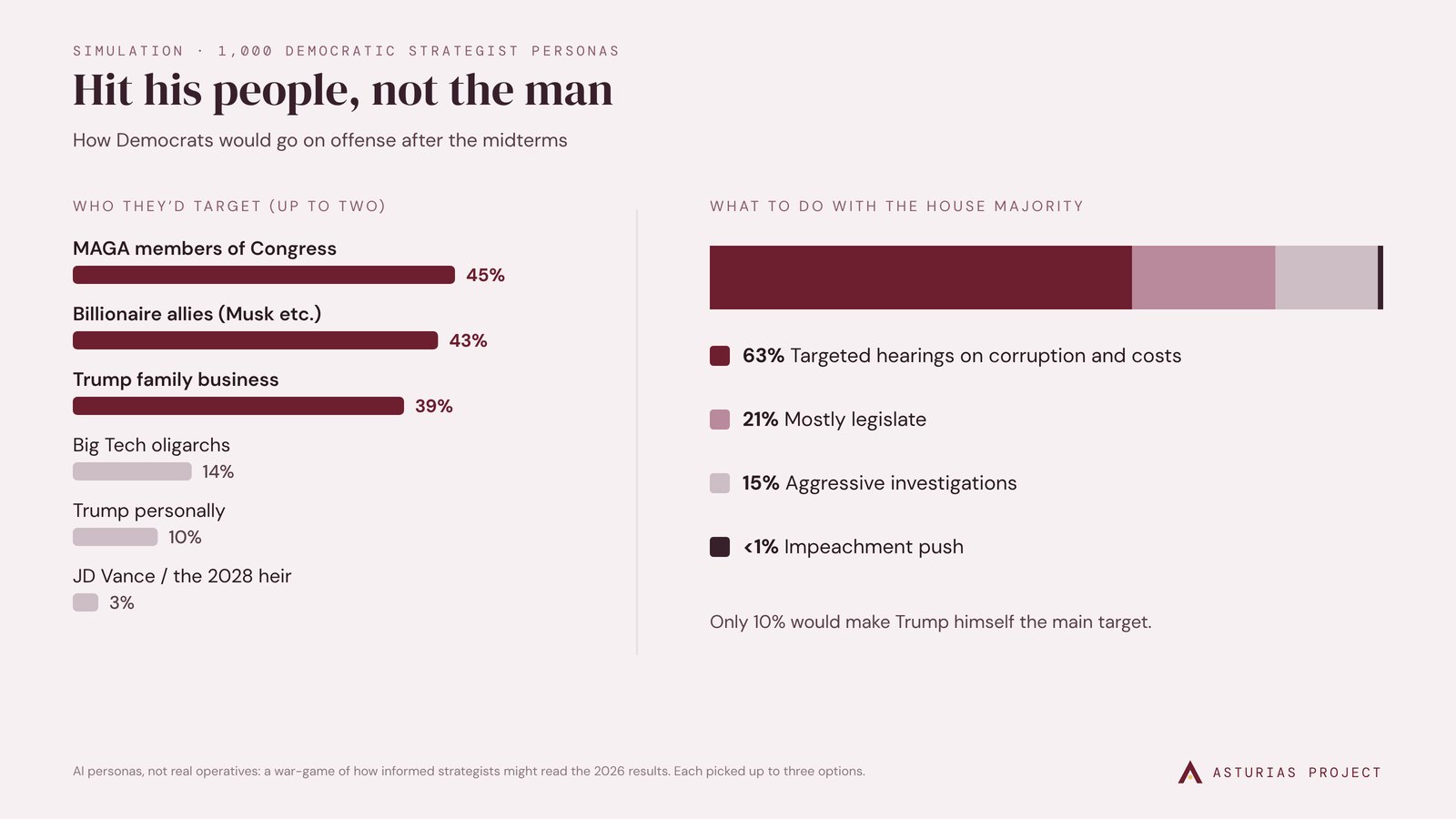
Up to two targets each. The fear that came up most: overreach that “turns a referendum on Trump into a referendum on us.”
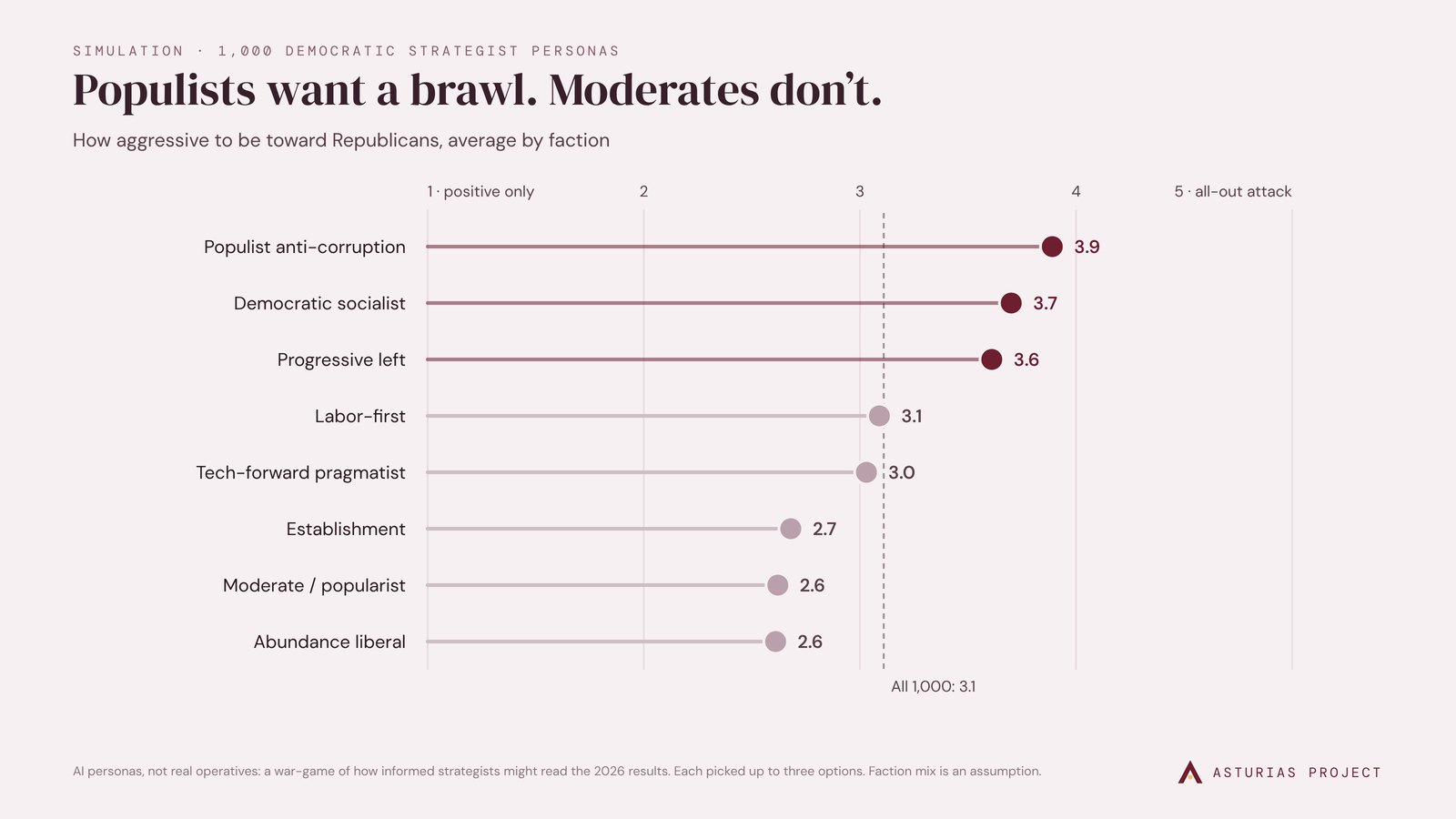
Self-rated aggression toward Republicans, 1 to 5, by faction. The faction mix is our assumption.
Tech and distribution: local, long-form and person to person
The lesson they drew from 2024 is that Democrats lost the attention war where persuadable voters, especially young men, actually spend time. AI stays mostly behind the scenes: message testing and modeling, with only 12% putting AI-personalized ads in their top channels for fear of a deepfake scandal.
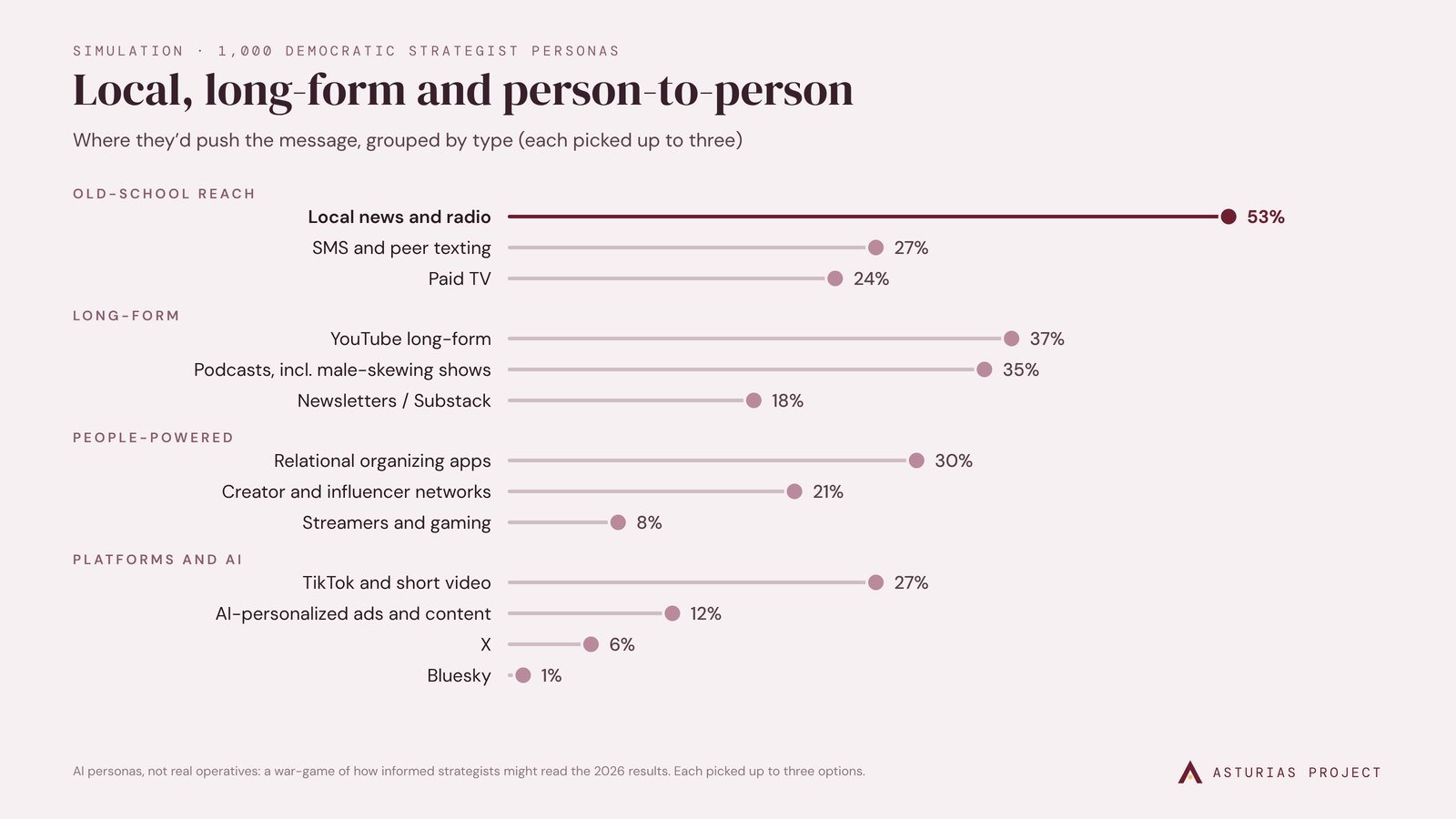
Up to three channels each. Local news rises to about two-thirds among personas in the South, the Midwest and the Mountain West.
People: who they’d put forward
The names they most want to elevate come from the Sun Belt and swing states and look like they could win where Democrats usually lose. Each faction has its own champion, and big names from the last cycle barely appear: Newsom 4%, Pritzker 2%, Harris none.
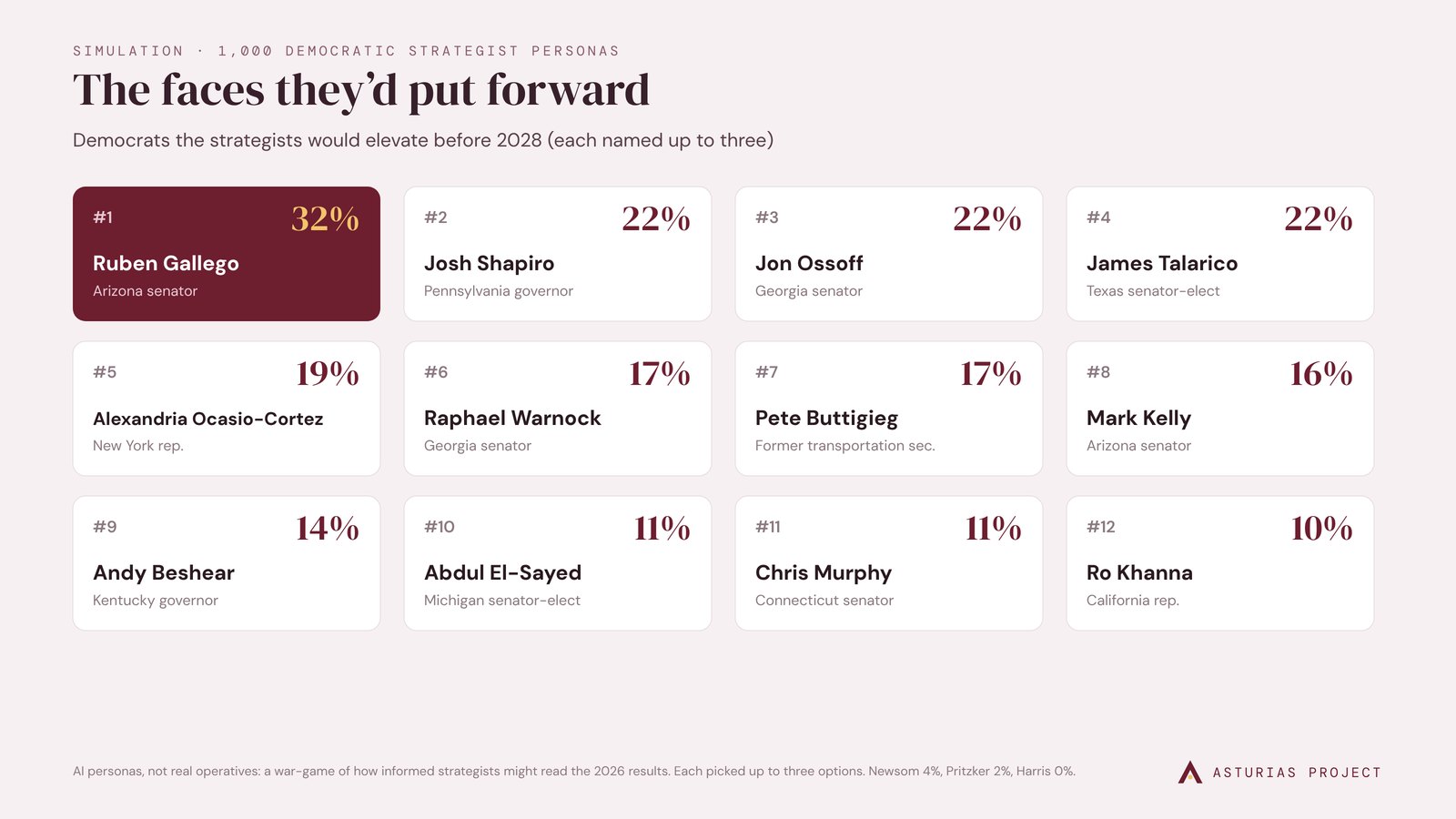
Free-text names, up to three each.
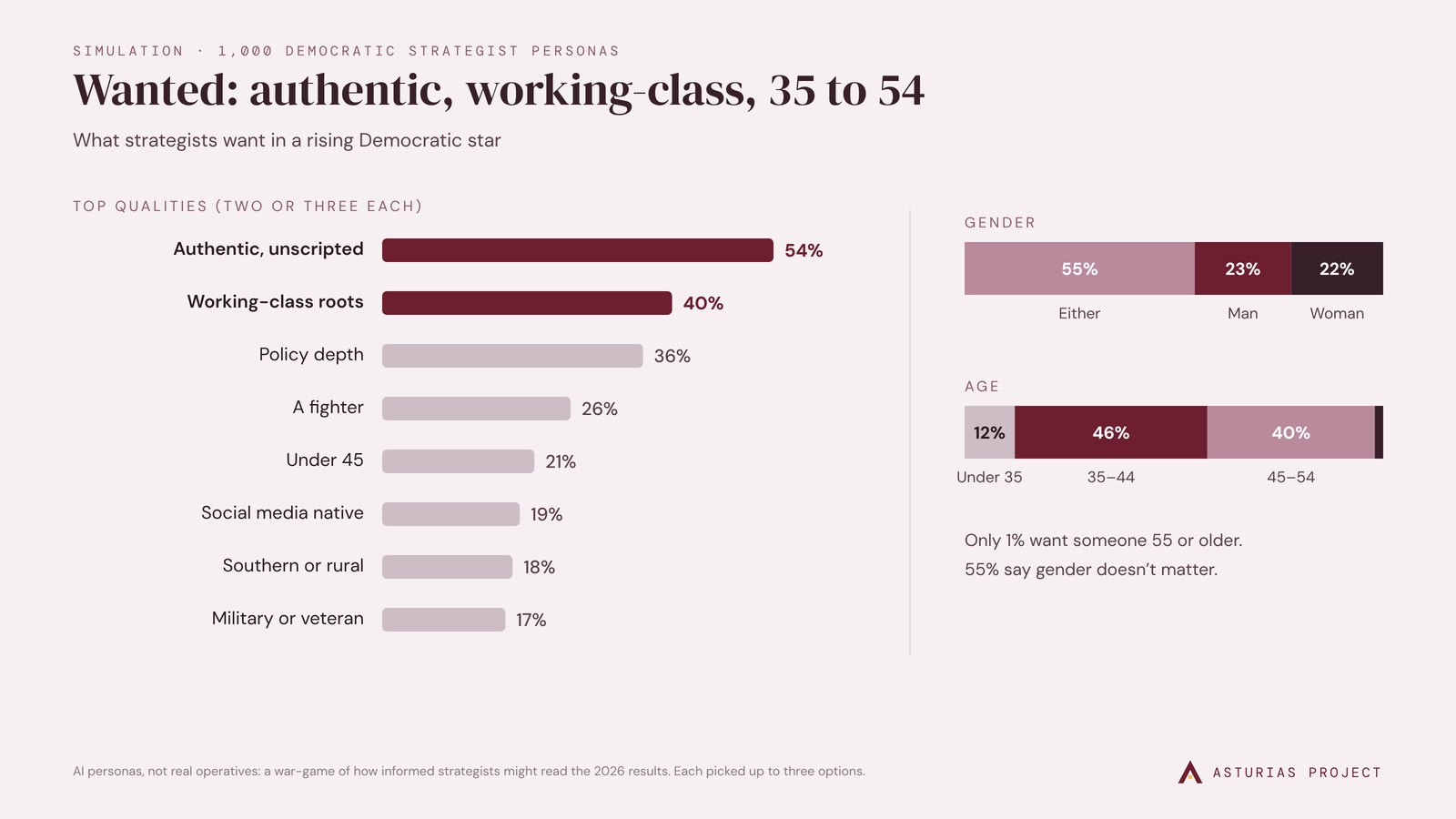
Two or three qualities each. In their words: “a man under 40 who lifts, games, has a real job history, and can handle a hostile podcast host with humor.”
Where they split
Agreement on prices hides a real contest over tone, economics and who leads. Most would keep progressives inside the tent without letting them set the battleground message: “I’ll put a progressive in my ads the day their message beats the control.”
| Faction | Share | What sets them apart | Champion |
|---|---|---|---|
| Populist anti-corruption | 16% | All lead with corruption; 95% would target the Trump family’s business | Talarico, Gallego |
| Progressive left | 15% | 68% want tax-the-rich; the only faction where most still emphasize abortion | Ocasio-Cortez |
| Democratic socialist | 6% | 98% want tax-the-rich; most open to aggressive investigations (42%) | Ocasio-Cortez, Mamdani |
| Moderate / popularist | 19% | Most likely to mute immigrant rights (47%) and to emphasize faith (32%) | Shapiro, Beshear |
| Establishment | 15% | Calmest on oversight; leads with health costs | Shapiro, Gallego |
| Abundance liberal | 12% | All lead with housing and abundance | Buttigieg, Shapiro |
| Tech-forward | 11% | Most comfortable with AI; leads on jobs in an AI economy | Gallego, Buttigieg |
| Labor-first | 7% | Least comfortable with AI; most focused on men and boys | Gallego, Warnock |
What this means for conservatives
The plan mutes exactly the issues that worked in 2024. The opening is the gap between that message and an activist base our trend tracker shows is loudest about fascism, genocide and identity.
They plan to own both. Leading with culture while they talk about grocery prices and self-dealing cedes the frame voters care most about.
Long-form podcasts, local radio, faith communities, veterans and the “men and boys” conversation are all on their list.
A Marine veteran, a seminarian who talks about faith, governors who run competent states: hard to paint as coastal elites.
Half the country still views the party unfavorably, the left flank wants a harder campaign, and young voters are “a loan.” Overreach is the risk they fear most.
How this was done
We built 1,000 fictional strategists: committee and campaign staff, pollsters, think-tank fellows, digital strategists, union political directors, outreach directors, opposition researchers, donor advisors and ad-makers. Each card set a role, a faction, a region, an age and a personal lens. Every persona read the same briefing built from published results and exit polls (AP VoteCast via PBS, CBS News exit polls), then answered mostly from fixed lists so the answers could be counted. The faction mix (moderate 19%, populist 16%, establishment 15%, progressive 15%, abundance 12%, tech-forward 11%, labor 7%, democratic socialist 6%) is our assumption and shapes the totals. These are AI personas, not real operatives; the results show what informed strategists might plausibly conclude, not what any real person or organization has decided.